How to Save Money When Studying Abroad

The foreign exchange specialist and managing director of Currency Change Laurent Guilbaud talks about how to save money when studying abroad.

  • What is the most common mistake that parents do when they exchange money?

    ‘Look around for the best deal’ says the managing director of Currency Change

They simply fail to realize they can reduce the expenses by considering currency risk at the early stage of arranging the international payments and by choosing the right currency provider.

  • When people want to buy consumer goods, they shop around. Do they do the same when they need to exchange money to send their kids to study abroad?

Unfortunately, they don’t. They just go to their local bank that usually offers them poor rates on top of bank transfer fees and additional receiving charges from the beneficiary bank abroad.

  • How parents can save money when they plan to send their child to study abroad?

My advice to them: Look around for the best deal. Ask your bank for a quote first. It will be a good reference point for comparing rates.  Also, check what the transfer charges are. The next step is to approach independent foreign exchange specialists and review their rates. Make sure though you choose a broker who is FSA (Financial Services Authority) authorized.

  • Exchange rates are constantly changing. When is the best time to make an international transfer?

The best way is to be attentive to currency movements. Also, use time to your advantage. Don’t leave the transaction the last minute. Even if you need the money in three months, it is better to ask your currency consultant to start working on your solution right away.

  • What are the 3 Do’s and Don’ts that people need to be aware of before they exchange money?

1. Don’t rely on your local bank to exchange and transfer your overseas payments. You might pay more that you should.

Do check independent foreign exchange (FX) specialists to find better currency deals and more personalized service.

2. Don’t be attracted by marketing phrases such as ‘competitive rates and 0% commission’ as this fee is then added to the exchange rate – which makes it difficult to get hold of the exact rate and compare it.

When choosing a currency provide, do compare exchange rates, transfer charges and fees of the beneficiary bank abroad.

3. Don’t overlook foreign exchange risk.

Do pay attention to the currency movements and ask your FX consultant for market insight and guidance how to manage your risk.

The bottom line: a small percentage difference in the cost of transferring money abroad can result in large savings. It is worth the effort.

Korina Karampela is the author of ‘b4iapply to college‘ and ‘b4iapply to uni‘ books. She talks to Laurent Guilbaud about how to save money when studying abroad.


Posted in Interviews, Value for money | Tagged , , , , | Leave a comment

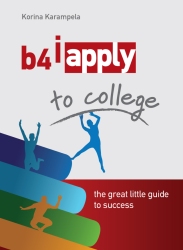
‘b4iapply to college: the great little guide to success’

The ebook b4iapply to college: the great little guide to success is a must-read for applicants who plan to study in the United States of America.

This book wants to inspire you to take control of your future. To be successful in this increasingly demanding world, you need to know where you are heading and become an expert at your chosen career.

This book will provide you with a 4-step framework to set you on your way. It aims to give structure to your research that will enable you to develop your OWN opinion about the path you want to pursue.

Unlike other guides which only focus on which college to choose, ‘b4iapply to college’ gets to the heart of the matter and helps you understand:

– who YOU are
– what sort of future YOU want
– which careers are right for YOU
– how can you get good value for YOUR money.

Having gone through the 4-step thinking framework, you will have significantly increased your chances of discovering early in life the career path that suits you best – what you are good at, that you enjoy and that you can excel in. Empowered with this knowledge, you will be able to take advantage of the unique resources that a college offers to build your expertise.

Don’t get into a debate regarding which college to choose before you are clear about which career path you want to follow. It is crucial to get the direction right first. Then you can evaluate various college options – based on quality of education in the field of your choice and affordability.

Practical and concise, this e-book is primarily intended for young people who plan to study in the US. Many parents and school counselors have also found it a very useful tool that helps them guide teenagers.

Korina Karampela is the founder of b4iapply, author of 2 books, coach and speaker. She has worked as senior pharmaceutical executive for 12 years and has an MBA from MIT Sloan. Her blog b4iapply is recommended by The Guardian for professional development.

Posted in b4iapply to college, Before I apply, Higher Education, Link education with career | Tagged , , , , , , | Leave a comment

How to choose a college degree: Plan the Dream

I have received a few emails lately from youngsters who consider going to university telling me that I paint a rather bleak picture about Higher Education.

To be totally frank: YES, I DO.

Not because I don’t believe in Higher Education. On the contrary, I am a huge advocate of education and continuous learning. In fact, I have studied a lot myself; on top of my bachelor’s degree, I did 2 masters in the UK and an MBA in the US.

I paint a bleak picture because the idea that those with university degrees will be better off is so entrenched in our psyche that we accept it without objection. It seems indisputable.

There are two words missing on the above statement in order to be correct. It should read as following: those with university degrees will be on average better off than those without them. In other words, the majority of graduates will be better off but some will not.

Who are the ones who are better off?

These are the ones who:

Be wise. Be selective.

  • are passionate about what they study,
  • choose a major that plays with their strengths,
  • select a college that is both academically rigorous and affordable,
  • work hard to get the most out of their degree,
  • are prepared to be out of their comfort zone (most of the time)
  • develop a social network (classmates, professors, mentors, etc) that will support them during education and career development, and
  • dream big and have clear goals at the same time – I call it Plan the Dream!

It is not just about getting a college degree. It is about getting the right degree for you. For example, if you are between becoming an engineer or a lawyer, you definitely have some research to do.

So, the only reason I paint a bleak picture about higher education is because I want you to think how to improve your chances to have a successful career and a meaningful life.

Even if you are not clear what you want to major in, it is crucial you get the general direction right as early as possible.

My hope is that by knowing the reality – both the opportunities and the challenges- you will augment your courage to explore options and take the risk to pursue your passion. So when you choose your college degree: dream big and have a plan; Plan the dream!

Korina Karampela is the author of  two ebooks: the UK edition ‘b4iapply to uni and the US edition ‘b4iapply to college’.

Posted in Before I apply, Higher Education, Link education with career, What to study | Tagged , , , , | Leave a comment

Student debt: who is to blame?

Most young people aspire to a higher education. It is considered to be the ticket to a fulfilling and prosperous life. This was their dream since they were little. The schools religiously prepare them for this moment for years. The social pressure is enormous. In their mind, a college degree is the only way forward – they want it at any cost.

As tuition fees soar, student debt accumulates. In order to pursue a bachelor’s degree almost everybody is getting a loan. 

The average amount of student debt in 2010-11 was $27,200. 10% of borrowers have more than $45,000 in loans. Unfortunately, most students don’t understand what they sign up for and they regret it later.

Check the small print before you sign


Should we warn the youth?

Yes. They need to realize that college education is not an entitlement. It is not free. In fact, it is a choice that comes at a significant cost. Even if students are offered some financial aid (grant or scholarship), the need to understand how much they will have to pay in the end and what the return on their investment will be before they make their final decision.

The easy-to-secure loans blur the picture as well. Remember, it is not free money. Some don’t even read the conditions. They simply sign the documents like approving  the new software update from Apple.

Since everybody is doing it, it should be ok.  NO, IT IS NOT. This is why nearly 1 in 10 who started repayment in 2009 defaulted within two years.

Are colleges to blame? Yes.

Although their job is attracting students, they should not urge them NOT to worry about the costs. This is irresponsible. Could they do a better job in advising about the financial realities of attending a college? Yes, they could and they should.

Are parents to blame? Yes.

No parent would like to say to their children that they cannot follow their dreams because of the price tag of the degree. They do have an obligation though to empower them to make informed decisions and help them understand their implications.

Parents need to encourage students to become financially savvy and think long-term.

Before making their final decision, applicants need to understand

  • how much they will owe and to whom
  • what the interest rate will be
  • what is the expected salary upon graduation
  • what their monthly repayment will be
  • how long it will take them to repay the loan
  • what happens if they cannot find a job

Parents and students should sit down and figure out if the price of education is affordable. While getting a college degree from a prestigious university is important to compete in today’s job market, American families need to understand the implications of not being able to repay loans. They may have to consider more cost-effective options.

We want higher education to be a ticket to a successful life – not to default.

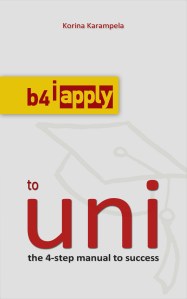
Korina Karampela is the author of  the ebook ‘b4iapply to uni: the 4-step manual to success.’ The US edition ‘b4iapply to college is NOW AVAILABLE exclusively on Amazon.

Posted in Before I apply, Student loans | Tagged , , , | 2 Comments

The book ‘b4iapply to uni’ is now available in more countries

Acting upon the request from the readers of this blog, the English version of the book ‘b4iapply to uni: the 4-step manual to success’ is NOW AVAILABLE on Amazon Kindle in the following countries:

  • France
  • Germany
  • Greece
  • Bulgaria
  • Cyprus
  • Ireland &
  • New Zealand

This book empowers students to think differently.

It provides them with the framework to identify career options that fit their strengths and interests and have promising future prospects. Empowered with this knowledge, they can make an informed decision about what to study at university to enable them to pursue the career they want.

Please ADD YOUR REVIEW on Amazon after reading the book. It will help others in their decision-making process.

Also note that even if you don’t have a kindle, you can download a kindle app for free. It is available for: PC, Mac, iPad, iPhone, Android phone or tablet, BlackBerry, or Windows Phone 7.

A Big Thank You for supporting b4iapply’s mission to empower students to make informed decisions and take responsibility for shaping their futures.

Korina Karampela is the founder of b4iapply, author of 2 books, consultant and speaker.

Posted in Before I apply, Career Advice, Higher Education | Tagged , , , , , , | Leave a comment