How to Find the Right Coach – Interview with Sir John Whitmore

Korina Karampela talks to Sir John Whitmore – author of the best-selling book ‘Coaching for Performance’ and Executive Chairman for Performance Consultants– about the value of coaching for professional advancement and how to find the right coach.

  • How can coaching help people unlock their potential?

People need to feel confident and  safe to express their potential. Coaches need to be friendly, optimistic and encouraging to produce this effect, but they must be honest too in the way they communicate. They need to know that everyone has far more potential than they think they have – including themselves!  The coach can ask challenging questions. How can you achieve this? Have you done something like this before? What happened? What might you add next time?

  • What is the most common misconception that business leaders have about coaching?

The word coaching was first used in sport where it was, and still is, used by some in a very instructional way. The workplace application of coaching is more modern. Coaches support their clients by asking deeper questions to help them become more aware of their own capacities and that of their staff. Then, their staff need to be trusted to take greater responsibility for their decisions and actions.

Coaching is not about instructing but encouraging people to find their own best way. Coaching is not telling people what to do but trusting them that deeper down they really do know what to do.

  • If you were able to make one change to improve the quality of coaching offered, what would it be?

    How to find the right coach

    “Everyone has far more potential than they think they have” says Sir John Whitmore

Some of the coaching training programmes on offer are too academic, prescriptive and even bureaucratic and they should be more natural and person focused. People skills are essential for high quality coaches. There is not one way to do anything; we all walk differently; we do it the most comfortable and efficient way for our own physicality and our own psychology at that time.

A good coach is able to understand there are other ways to do things and don’t force people into their way or old ways. A young athlete called Fosberry, changed the way the whole world did the high jump. He did it his way (the Fosberry flop) which was better that all the other so called experts.

  • What are the 3 ‘Do’s’ and 3 ‘Don’ts’ executives who want to appoint a coach need to be aware of?

The Do’s are:

  1. Do think how you want to be coached. Do you like to be challenged or do you prefer a more gentle approach? When you know what coaching style you are looking for, it will be easier to find the right person to work with.
  2. Do ask your network for recommendations.  Find out whether they established an open and honest relationship with their coach. If they did, it is a good sign.
  3. Do have an interview with two or three potential coaches before making any commitments. Spend 30 minutes with each of them and decide at the end with whom you would like to work with.

The Don’ts are:

  1. Don’t assume that because one coach was right for a good friend of yours, he or she will also be right for you. Each person is different. Find out whether there is chemistry between you and the coach before you commit.
  2. Don’t be afraid to stop the relationship if you feel uncomfortable with your coach or there is a breach of confidentiality.
  3. Don’t underestimate the importance of trust in this relationship.To get the best results, you need to feel at ease with your coach, respect him and be completely honest with him.

The bottom line: A coach can help you achieve your potential as long as you also have a fierce desire to learn and grow. Do your due-diligence to find the right coach for you.

Korina Karampela is the founder of b4iapply, author of 2 books, consultant and speaker. She has worked in senior positions in the pharmaceutical industry for 12 years and has an MBA from MIT Sloan. Her b4iapply blog is recommended by The Guardian for professional development.

Posted in Career Advice, Career Change, Coaching, Personal development, Professional development | Tagged , , , | Leave a comment

UCAS Clearing: Six (rather harsh) Choices to Make

How to Get Prepared for UCAS Clearing

b4iapply

The A-level results day is looming.  Most students will be very happy with the news. Those who won’t achieve the required grades, they will have to take some decisions.  As George Clooney’s character Chris Kelvin (the protagonist of the sci-fi movie Solaris) says: “There are no answers, only choices.”

With the advantage of looking back and thinking what I could have done differently, I’d like to share with you six (harsh) choices I suggest you consider. You may agree with me or not. It is up to you to decide. Irrespective, I’d be happy if you think of them for a moment and happier if you just let me know your thoughts. UCAS clearing: There are no answers, only choices

1. Failure vs. Opportunity

There is no doubt that life has its ups and downs. However, how we deal with them can make all the difference. So, you either start beating yourself why you didn’t study more…

View original post 741 more words

Posted in b4iapply to uni, Higher Education, Link education with career, What to study | Tagged , | Leave a comment

Are Liberal Arts Degrees Still Valuable?

Korina Karampela talks to Sheila Curran and Suzanne Greenwald – the co-authors of the ‘Smart Moves for Liberal Arts Grads‘ – about the value of liberal arts education and whether it has changed due the recent economic recession.

  • How can a liberal arts degree set up young people for career success?

Today’s graduates enter a work world where they will likely change jobs and careers multiple times.  Liberal arts graduates, in some ways, have a certain advantage in the strategic use of their transferable skill sets.  With a strong foundation in problem solving, critical thinking, analytical reasoning, and communication skills, to name a few, liberal arts grads navigate well in the real world of career adaptation.  Regardless of subject matter, they apply valuable professional skills in a variety of workplaces.

  • Did the recent economic recession change the career prospects of the liberal art graduates?

Yes. When the market constricts, liberal arts grads tend to feel it the most. Employers need to sift through hundreds of applications, and they can afford to be picky, selecting only those with the most relevant experience.  And there’s the rub.  Experience.  Liberal arts grads need to put their skill sets to the test. Real work experience, often through early internships, will help set their resumes apart.  Also, this is an excellent, relatively low risk way to get one’s feet wet in a particular field.  Or rule out one field to make way for another.  

"Real work experience, often through early internships, will help set their resumes apart" says Suzanne Greenwald.

“Real work experience, often through early internships, will help set their resumes apart” says Suzanne Greenwald

Only then, can liberal arts grads start to effectively articulate how they successfully used their skills to solve a certain problem, organize a project, communicate an idea, realize their potential. This will also help them learn to play to their strengths. Often, the “hook” for a liberal arts grad is a weak spot in the workplace, such as strong communication skills.

  • What is the most common misconception that people have about liberal arts degrees?

The biggest misconception is that liberal arts grads want to go into the field of their major.  But in fact, the Psychology major may be in interested in small business marketing and development.  The Russian Studies major may be interested in global health or the foreign service.  The English major may be interested in social media networks.  

There is this myth that studying liberal arts is a luxury.  That it’s a fast path to unemployment.  It’s certainly true that, even in the best colleges, jobs are hard to come by.  But, if students supplement their liberal arts education with critical, relevant work experience, emphasizing application of strengths, theirs is just as competitive as any other job seeker on the market. 

  • What are the 3 ‘Dos’ and ‘Don’ts’ young people who consider getting a liberal arts education need to be aware of?

    " There is this myth that studying liberal arts is a luxury" says Sheila Curran

    ” There is this myth that studying liberal arts is a luxury” says Sheila Curran

The Do’s are:

1. Do get as much work experience as possible.  Find internships that truly are learning experiences, not just “doing time” in an office making copies and getting coffee.

2. Do learn how to tell a compelling story about why you chose your course of study.  Then, connect the dots.  What does that course have to do with your professional interests and personal aspirations? 

3. Do build your connections web and learn how to effectively network. Start with alumni in fields that interest you. Keep refining your story and your interests through your conversations.

The Don’ts are:

1. Don’t wait until your final year to start thinking about your career. You’ll have already missed out on too many summers of potential work experience.

2. Don’t listen solely to your parents and friends. They love you, they support you, they’ve got your back.  But, they don’t often know what it takes to be successful in this modern-day economy.

3. Don’t burn any bridges.  For example, don’t accept a position then renege on an offer.  Don’t ignore the receptionist on your way in or your out of an interview.  Don’t make people angry because this is what you will be remembered for, not your sterling list of accolades and achievements.

The bottom line: To improve job prospects, liberal arts students need to aggressively pursue internships and other career-advancing opportunities while at school.

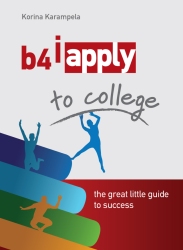
Korina Karampela is the founder of b4iapply, author of 2 books, consultant and speaker. She has worked in senior positions in the pharmaceutical industry for 12 years and has an MBA from MIT Sloan. Her b4iapply blog is recommended by The Guardian for professional development. She is the author of “b4iapply to college: the great little guide to success“.



Posted in b4iapply to college, Higher Education, Link education with career | Tagged , , | 3 Comments

How to Deal with Self-Doubt During a Career Change

Meet Emma – She is in her mid-40s. She has been working in the corporate world for more than fifteen years. In order to spend more time with her teenage children, she decided to work as freelancer. It was definitely a big decision but it is something that she has been thinking for some time. She always wanted to be “her own boss”. Emma felt that the time to make her dream a reality has come. “If it doesn’t happen now, it will never will” she thought.

Three months have passed since she set up her own company and she hasn’t manage to land a project. Although she is a very competent project manager, she finds it difficult to promote her services. She has started questioning her decision to leave a comfortable and well-paid career. Self-doubt is creeping in.

If you are going through a similar situation, it is important that you stay positive and put things into perspective.

By letting the set-backs you face during the transition to affect your confidence, you actually do nothing that helps the situation improve. On the contrary, you may miss significant opportunities; people want to work with people who are competent and have a positive attitude.

Here are some techniques to consider that may help you to stay optimistic:

  • Celebrate small successes. Make sure you appreciate the progress you are making. “Rome was not built in a day.” Be persistent in driving towards your goals but also accept that it might take longer that your originally thought. Cherish the small early wins to build your momentum.

    How to deal with self-doubt during a career change

    Stay positive and put things into perspective

  • Keep fit. Eat healthy food, sleep well and do a sport. Being physically fit is paramount to your emotional well-being.
  • Get involved in activities where you can see improvement. Run, swim, learn a language. When you see progress, you will feel a sense of achievement and it will be a big confidence booster.
  • Put a stop to the spiral. Avoid generalizations like ‘I am not good enough’ or ‘I don’t deserve it’. Stop bad thoughts as early as possible. Make a realistic assessment of the situation, identify what doesn’t go well and fix it. Don’t allow yourself to go to an emotional roller coaster. Your confidence is the most important asset you have.
  • Meditate. This technique might NOT work for everybody. Professional sport people use it all the time. They use breathing techniques to relax and visualize themselves achieving the goals they have set.
  • Allow the occasional outburst. There is no doubt that you will need a shoulder to cry at some point. Most of us do. Gather your pieces the following day and continue working towards your goals.
  • Talk to people who have done a similar transition. You will quickly realize that everybody’s journey was bumpy. Success didn’t come easy to anybody even if it looks like this from the outside. The thought that you are not the only one who faces challenges might be a comforting one (at least for some time).
  • Get a hobby. Do something that you always wanted to do but your never had time. Associate your transition with positive experiences. Find a way to decompress from the everyday pressures.

The bottom line: Making a career change can be stressful. Expectations are high. The reality though is that you will probably face some ups and downs along the way. Also, it usually takes longer than you think. Staying positive is critical.

Korina Karampela is the founder of b4iapply, author of 2 books, consultant and speaker. She has worked in senior positions in the pharmaceutical industry for 12 years and has an MBA from MIT Sloan. Her b4iapply blog is recommended by The Guardian for professional development.

Posted in Career Advice, Career Change, Professional development | Tagged , , | Leave a comment

How to Reinvent Yourself for a Successful Career Change

Meet George – He is in his late 30s. He has been in his current position for almost four years. He was very enthusiastic about his job during the first couple of years. He doesn’t feel challenged anymore. At the same time he can’t see any opportunities for promotion. He has lost interest and the whole situation has an negative impact on his mood. He has been thinking of a change for some time now.

When I asked him what he would like to do in the future, George responded “This is the problem. I don’t know.” When I asked him what his strengths are, he stated a long list of weaknesses. The only thing he was clear about is that he can’t afford to take a pay cut to start something new.

Like many people, George is dissatisfied with his current job. He wants to make a change but he doesn’t really know what direction to take.

For those in a similar situation, here are some tips to consider:

  1. Don’t run away. If you are unhappy with what you do at the moment, figure out what is wrong and fix it before you decide about your next steps (e.g. build your confidence, act on constructive feedback, repair broken working relationships). Running away will not solve the problems. Similar ones may appear again at your next job.
  2. Find out what your strengths are. This step is very important. Even if you think you know them, take the opportunity to reflect once more. Observe how you deal with situations and think what you are doing well and what you need to improve.  You may want to do some psychometric tests (search online to find personality tests that fit your needs). Some simple things like asking friends and colleagues for feedback might also give you a different perspective. If you can’t articulate what you are good at, how are you going to convince others when you will be looking for another job?
  3. Explore what you want to do. This is the most difficult phase and the reason is
    Career Change

    You won’t find out what you want until you try it

    simple; our interests and career aspirations change over time.  What seemed appealing in our 20s might not be in our 30s. It is possible to have multiple careers during our working life. Make sure thought that you are the one who defines your career direction. Remember: if you don’t take control of it, nobody else will.

  4. Try things out and learn. When career paths look appealing, test them before you make any decisions. Talk to people who work in that field, volunteer for short projects, take relevant courses if specific skills are needed, etc. Experiment first. Then reflect whether you still want to pursue this path. A step-wise transition might work better than a drastic change.
  5. Make a career plan. When you have clarity on your career goals, make a realistic plan. Are there gaps in your skills and experience you need to address? Do you need to retrain?  Can you do an internship? Make sure you ask potential employers what they are looking for in a candidate. If you plan to set up your own business, develop a business plan and talk to other entrepreneurs who have gone through this journey.
  6. Develop a network. Relationships matter to your career. Invest time in developing and strengthening relationships in the sector you want to move in. They can be a key source of information and support.
  7. Plan your finances. “Do what you love and money will follow’ is not a good advice. In case you plan a significant career transition, start saving as much money as you can. Things will be easier when you don’t have to worry for the everyday needs at least for a period of time. Also, do you have a Plan B in case Plan A doesn’t work out?
  8. Manage your emotions. Be prepared that fear and self-doubt will creep in at some point. Fear usually comes  due to the unknown. At the same time, there is no risk-free career plan. There will always be risk involved irrespective whether you stay at your current job, you change companies or you decide to do something different. The best way is to do your research, explore the available options, understand their trade-offs and then make informed decisions.

The bottom line: If you are unhappy with your job, do something about it. Don’t expect things to happen to you. Make them happen. Do nothing is not a risk-free option anymore.

Have you gone through this type of experience? If yes, what worked for you?

Korina Karampela is the founder of b4iapply, author of 2 books, consultant and speaker. She has worked in senior positions in the pharmaceutical industry for 12 years and has an MBA from MIT Sloan. Her b4iapply blog is recommended by The Guardian for professional development. This article has also been published in Huffington Post.

Posted in b4iapply for a job, Career Advice, Coaching, Professional development | Tagged , , , , | 2 Comments