11 questions to ask yourself before you apply at university

Most students forget to take into consideration where they want to live and work in the future. Although it sounds like a trivial question, it is important that you find which work environment is ideal for you before you apply at university.

Here  are 11 questions that you need to ask yourself:

  1. Do you want to live in big cosmopolitan city, in a mid-sized one, or in a rural area?
  2. Do you prefer working in a small entrepreneurial company or a national/ international one?
  3. If you had to choose between working for a non-profit or for profit company, which one would you go for?
  4. Do you want to work in the private sector or the public one?
  5. Would you most enjoy working on your own or as part of a team?
  6. Do you want your job to include travel or not at all? If yes, how much?
  7. Do you prefer working outdoors or indoors?
  8. What type of clothes do you want to wear at work? A suit/trendy clothes/uniform or whatever you want?
  9. Would you prefer the atmosphere at work to be casual or formal?
  10. Are you interested in working in a structured and hierarchical setting or would you prefer a creative and collaborative one?
  11. Would you consider living in another country for some time or not?

Although you might be flexible for the majority of these topics, it will be beneficial to understand what your ideal working environment is; the environment where you can excel.

Even if you don’t have all the answers yet, it’s ok. Now that you are aware of these 11 questions, you will start noticing things that you didn’t before.

Korina Karampela is the founder of b4iapply, author of 2 books, consultant and speaker.

Posted in b4iapply to college, b4iapply to uni, Before I apply, What to study | Tagged , , , | 1 Comment

What to study at college? New challenges call for new strategies

What do you want to study at college? is the question I ask all the teenagers I get the opportunity to meet. The majority of you are honest enough to tell me that you have no idea! I completely understand you. It is not an easy decision to make.

At the same time, you  have started realizing some unpleasant facts in addition to the increasing student debt you will accumulate due to higher tuition fees:

  •  A college degree does not guarantee you a job anymore. It only increases your chances and you need to have realistic expectations of what a degree can offer you.
  • Job prospects vary widely across majors and this must impact how you decide on what and where to study.

The world is changing fast, culturally and economically.  New challenges call for new strategies.

Before you apply to uni, think whether this course will help you get the career you want. If not, think again!

Traditionally, the approach to pursuing higher education focused on selecting a good university – in the current economic climate, this approach is no longer effective.   You need to think long-term. You will be better off by identifying what career you want to pursue and choose a major that will help you make this happen.

University is not an end in itself; it is the means to achieve the career you want.

In order though to find early enough the direction you want to head in, you need to invest time and effort in your research asap; with the same discipline you invest your time and effort to get the grades required.

If you get it wrong, it will take you time and money to change it (I have experienced this first hand). If you get it right though, you will have a meaningful career and fulfilling life. Getting off to a good start is key to your success.

Posted in b4iapply to college, Before I apply, Higher Education, Link education with career, What to study | Tagged , , , , , | 1 Comment

Where do you see yourself in 10 years?

Where do you see yourself in 10 years? I was asked this question for the first time during the interview for my first job. I agree with you; it’s an annoying interview question.

I don’t recall my answer (I got the job in the end, so it was probably something acceptable). However, I remember thinking that I had no idea where I saw myself the following year, let alone in 10 years.

You probably feel similar. This is perfectly understandable. It will be useful though to start picturing yourself in the future.

Try to visualize where you want to be in 10 years’ time. Think big picture. For example, do you see yourself:

a) working with animals, having a family and living close to the sea;

b) as a mover and shaker of the corporate world; or

c) setting up your own company in your hometown.

Go back to the things that motivate you. Paint the picture with these in mind. Write down how you envisage yourself in the future.

There is no right or wrong answer. It is up to you to decide what and where you want to be.

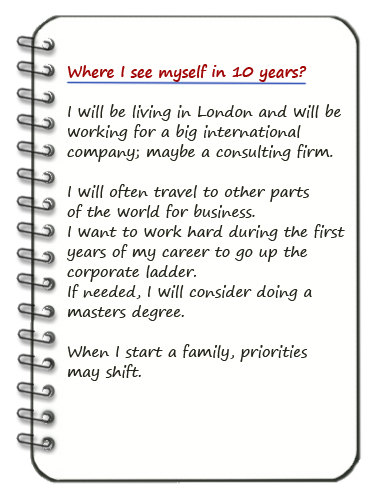
Here is an example of how David sees himself in 10 years

It will help you a lot to have a long-term goal. When you have a specific goal in mind, you filter all the information you receive in a way that enables you to make this happen.

Do you remember the last time you wanted to buy, for example, a specific mobile phone. Suddenly, you start noticing everybody else’s mobile phone. You can spot who has one similar to the one you want from miles away.

The same thing happens when you have a specific goal in mind. You filter all the information you receive (and you are bombarded by information every second) in such a way that you can identify all the opportunities that will help you achieve it.

Life, of course, can have unexpected turns. It is important though to have a long-term goal so you know where you are heading even if you have to change it along the way.

Korina Karampela is the founder of b4iapply, author of 2 books, coach and speaker. She has worked as senior pharmaceutical executive for 12 years and has an MBA from MIT Sloan. Her blog b4iapply is recommended by The Guardian for professional development.

Posted in b4iapply to college, b4iapply to uni, Before I apply, Career Advice | Tagged , , , , | 2 Comments

4 ways to become more employable

The labour market is changing fast. Unfortunately, both secondary and higher education adapt to these changes at a remarkably slower pace. Hence, there is a lot of discussion that graduates are not equipped with the necessary work skill-set.

In general, employers are seeking for people who can:

  • work in teams. At a work setting, success depends on how well a team can collaborate. Unfortunately at schools and universities,  it is individual performance that is mainly assessed. There are very few projects that prepare students to work with others.
  •  be flexible and adaptable. New technological advancements and unexpected challenges require people who can continuously develop themselves. Lifelong learning will be necessary.

What do you need to do now so you can become more employable?

Here are some suggestions:

  1.  Participate in team projects organized by your school (e.g. Young Enterprise). You will get a good understanding of the benefits and the challenges when working as a team.
  2. Get some work experience under your belt. Take every possible opportunity to work even for a short period of time (summer jobs, paid or unpaid internships, etc). It will be an invaluable experience for you. It is only by doing that you will learn what you like and what you are good at.
  3. Consider a gap year e.g.you can get a temporary job in Australia, volunteer for a humanitarian project in South East Asia, etc. You will learn to work in culturally diverse environments. In the truly globally connected world we live, this will be a key competency for the future.
  4. Learn a foreign language. There is no doubt that business is mainly done in English. Nevertheless, it will be a huge advantage if you can master one of the languages of the upcoming superpowers e.g. think of learning Chinese.

Getting involved in the initiatives mentioned above will strengthen your resume. It will send a clear signal to potential employers that you realize there are many opportunities out there and you willing to put energy and effort to make things happen.

The bottom line: By participating in extra-curriculum activities, you will learn a lot and you will stand out from the crowd. As a result, you will become more employable.

Korina Karampela is the founder of b4iapply, author of 2 books, coach and speaker. She has worked as senior pharmaceutical executive for 12 years and has an MBA from MIT Sloan. Her blog b4iapply is recommended by The Guardian for professional development. 

Posted in b4iapply to college, b4iapply to uni, Before I apply, Career Advice, Job search | Tagged , , , , , | Leave a comment

What motivates you to perform at your best?

Before you decide which career path to choose, it is important you understand what makes you perform your best.

Think of a moment when you were super-energised, motivated and engaged.

  1. Where were you?
  2. What were you working on?
  3. Who else was there?

Try to think of some other examples. Can you see a pattern?

It is important to understand what motivates you so you can match what you want with the jobs out there.

Most people would think that money is the primary motivator; everybody wants to have a bigger salary and great benefits. The truth though is different. Although money is important and people want to earn enough to have a comfortable life, there are many other reasons that push our performance to the peak.

Here are some more:

  • Recognition: hearing others telling you that you are doing a good job – especially by those who matter to you
  • Development: having opportunities to learn new things and develop new skills
  • Competition: being able to compete with others and have the chance to outperform them
  • Belonging: being a member of a team and feeling a real bonding with the group
  • Security: feeling that you and your family are safe and they are not at risk in any significant way
  • Purpose: making a contribution to a bigger cause that benefits other groups or the society as a whole
  • Autonomy: being free to do things the way you want

Which of the above motivators are important for you?

You will find out that probably there is more than one thing that motivates you!

Note that the importance of these motivators will change at different stages of your life e.g. security maybe not very important for you now but it might become more important when you have your own family.

Hence, when choosing a career, you need to consider not only what motivates you now but also what might motivate you in the future. You will be better off to follow a path that creates the optimal environment for you to perform at your best.

Korina Karampela is the founder of b4iapply, author of 2 books, coach and speaker. She has worked as senior pharmaceutical executive for 12 years and has an MBA from MIT Sloan. Her blog b4iapply is recommended by The Guardian for professional development.

Posted in b4iapply to college, b4iapply to uni, Before I apply, Career Advice | Tagged , , , | 3 Comments